Contrasting responses of soil silicon forms to different nitrogen−addition approaches
Atmospheric N deposition caused by human activities has dramatically affected terrestrial ecosystem Si cycling, especially in tropical and subtropical forests. Soil Si dynamics play important roles in plant growth and defense and are tightly linked to silicates weathering processes, with direct consequences on carbon dioxide (CO2) consumption. Many studies based on experimental platform of understory N addition have proved that long-term N addition significantly reduced plant-available Si and pedogenic Si. However, understory N addition may overlook various canopy processes, therefore, it may not fully reflect the effects of atmospheric N deposition on soil Si forms in forest ecosystems.
Based on the 12 year’s canopy and understory N-addition experiment at Shimentai National Nature Reserve, Yu et al. (2026) explored the contrasting effects of different N-addition approaches on soil Si forms and underlying mechanisms. Results revealed divergent effects of N-addition approaches on topsoil Si forms. Canopy N-addition led to significant increases in CaCl2-Si, acetic-Si, and oxalate-Si. This was attributed to the increase in poorly crystalline pedogenic oxides, which might provide enhanced adsorption sites for Si. In contrast, understory N-addition significantly decreased soil pH and increased soil organic carbon, which enhanced amorphous/biogenic forms of Si (H2O2-Si, Na2CO3-Si, and biogenic Si). Interestingly, CaCl2-Si (plant-available Si) was positively correlated with Na2CO3-Si and biogenic Si only in deeper soil, but with acetic-Si and H2O2-Si in both soil depths.
These findings imply that biogenic Si may not be the only source of plant-available Si and that sorption/adsorption processes are also critical for regulating Si mobility. These results demonstrate different mechanisms by which canopy and understory N-addition treatments affect soil Si forms, and highlight the necessity and importance to unbiasedly assess the effects of atmospheric N deposition on Si biogeochemical cycle in forest ecosystems, taking canopy processes into consideration.
The study titled “Distinct effects of long-term canopy and understory nitrogen addition on soil silicon forms in a subtropical forest” was published online in Geoderma. YU Heng was first author of this paper and Professor KUANG Yuanwen was the corresponding author. This study was supported by Guangdong Flagship Project of Basic and Applied Basic Research, the Key-area Research and Development Program of Guangdong Province, and Guangdong Key Laboratory of Applied Botany, South China Botanical Garden. Article link: https://doi.org/10.1016/j.geoderma.2026.117714
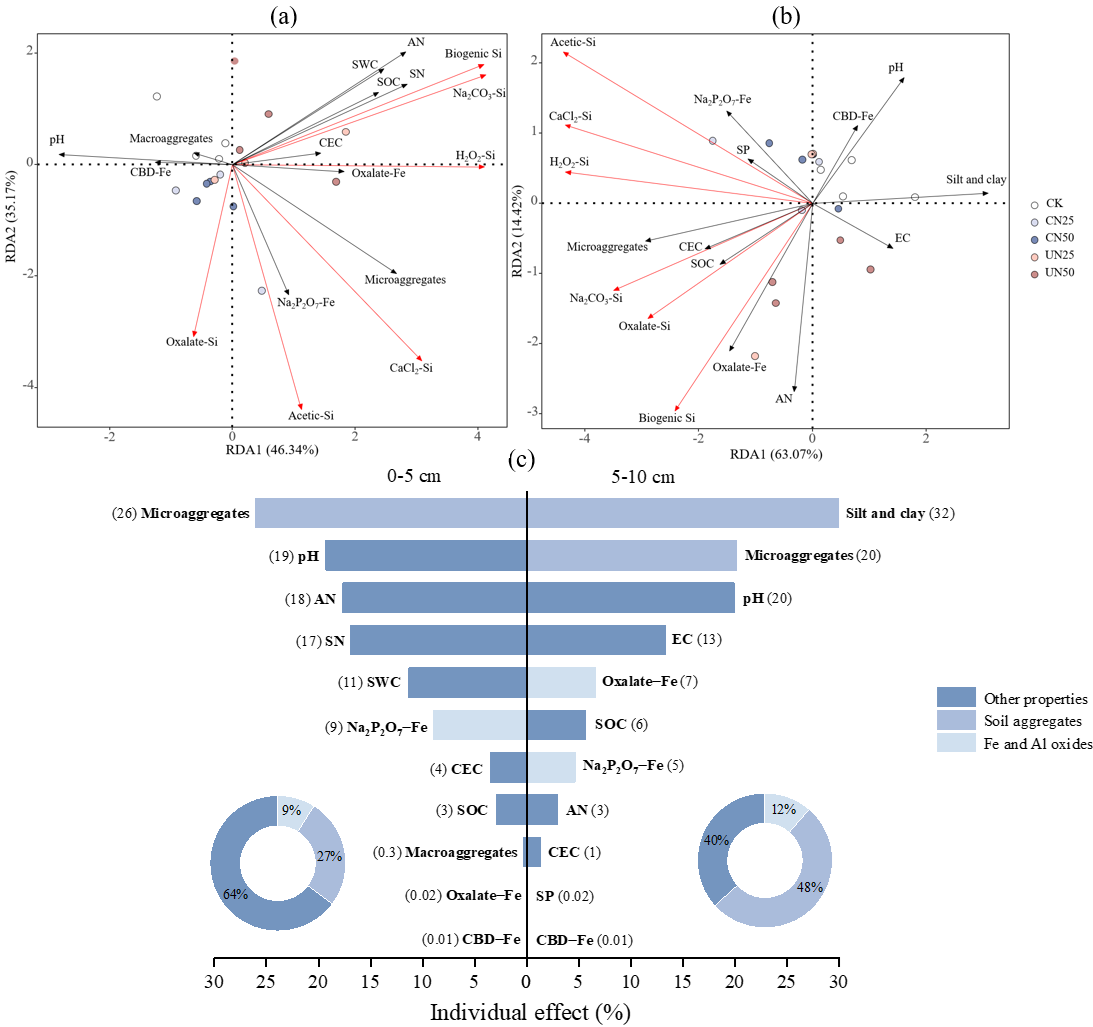
Fig. 1. Redundancy analysis of labile silicon (Si) forms with environmental variables at 0−5 cm depth (a) and 5−10 cm depth (b) and diagram of hierarchical partitioning (c), illustrating the explanatory power of environmental variables in influencing soil Si forms. SOC, soil organic carbon; SN, soil total nitrogen; SP, soil total phosphorus; CEC, cation exchange capacity; EC, electrical conductivity; SWC, soil water content; AN, available nitrogen.(Image by YU et al.)
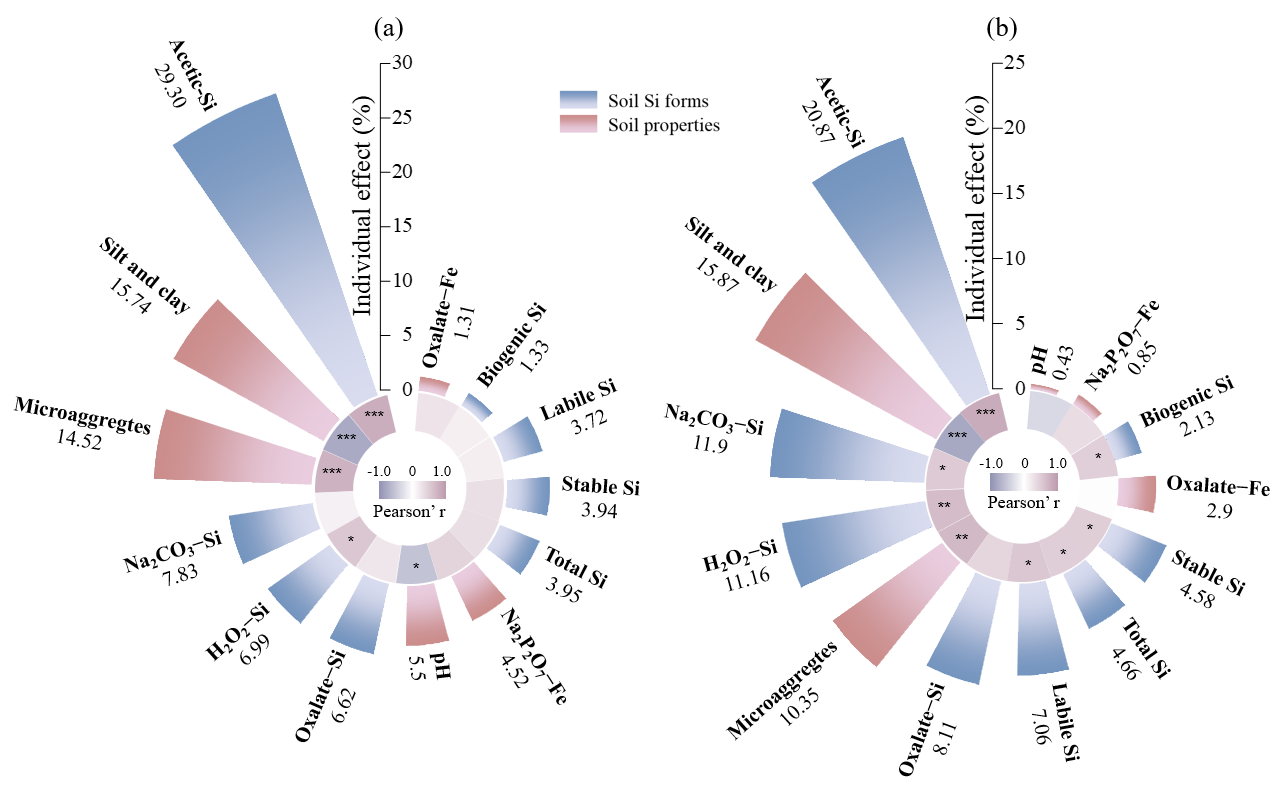
Fig. 2. Diagram of hierarchical partitioning and correlations at 0−5 cm depth (a) and 5−10 cm depth (b). The outer circle of figures show the explanatory power of environmental variables in influencing CaCl2−Si. The inner circles of figures show the Pearson correlations between CaCl2−Si and environmental variables. *, **, *** indicate significance at p < 0.05, p < 0.01, p < 0.001, respectively.(Image by YU et al.)
File Download: