Global change reshapes glomalin-mediated soil carbon sequestration by influencing plant inputs
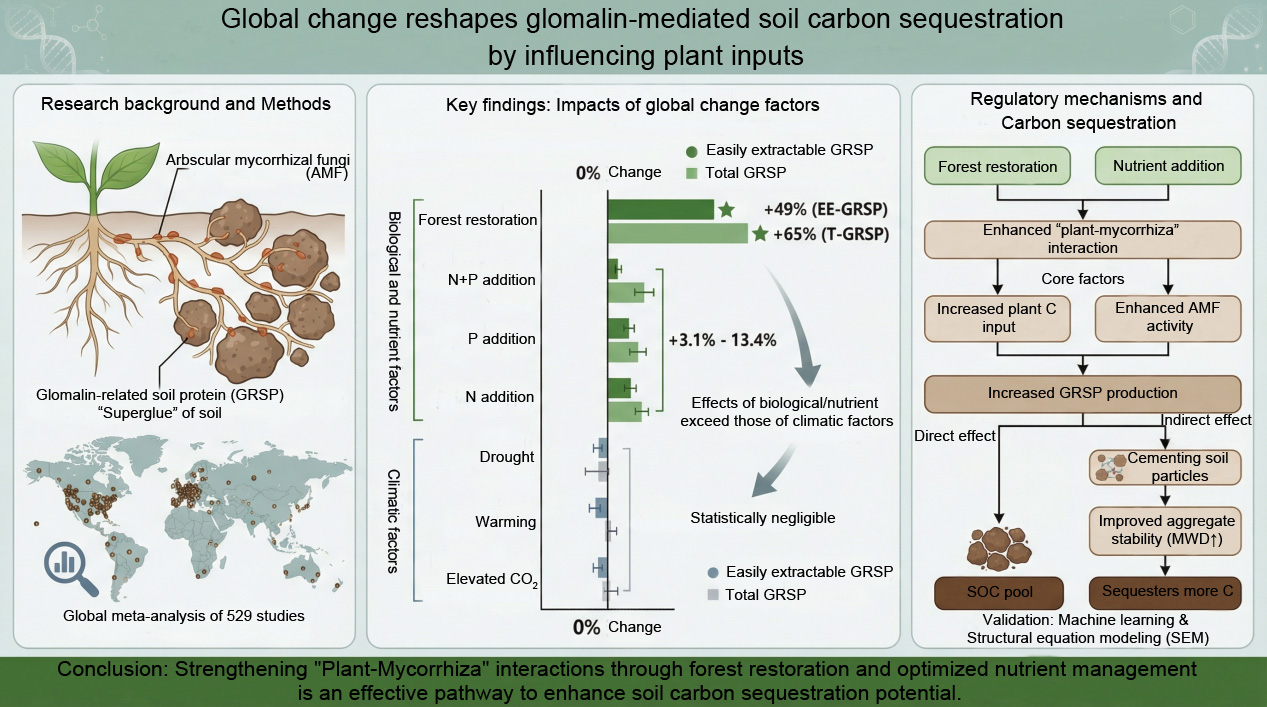
Glomalin-related soil proteins (GRSP), key metabolites secreted by arbuscular mycorrhizal fungi (AMF), are renowned as the "super glue" maintaining soil organic carbon (SOC) stability. However, under the backdrop of global climate change, the dynamic responses of this critical protein have not yet been quantified on a global scale.
Based on a meta-analysis of 529 studies across global terrestrial ecosystems, this systematically evaluated the effects of seven major global change factors—nitrogen (N) and phosphorus (P) addition, warming, elevated CO₂, drought, and forest restoration—on GRSP. This results reveal that biological and nutrient factors exert effects far exceeding those of climatic factors. Forest restoration yielded the most significant enhancement, increasing easily extractable GRSP (EE-GRSP) and total GRSP (T-GRSP) by 49% and 65%, respectively.
Furthermore, N, P, and combined NP additions alleviated nutrient limitations, stimulating plant carbon inputs and fungal growth, which raised GRSP content by 3.1%–13.4%. Surprisingly, the impacts of elevated CO₂, warming, and drought on GRSP pools were statistically negligible.
Validated by both machine learning and structural equation modeling, plant carbon input and AMF activity emerged as the core drivers regulating GRSP dynamics. Increased GRSP not only contributes directly to the SOC pool but also indirectly sequesters more carbon by cementing soil particles and improving aggregate stability (indicated by increased mean weight diameter).
This study confirms that, amidst global environmental change, strengthening "plant-mycorrhiza" interactions through forest restoration and optimized nutrient management to boost GRSP production is an effective pathway for enhancing soil carbon sequestration potential.
The study titled “Global change reshapes glomalin-mediated soil carbon sequestration by influencing plant inputs” was published online in Functional Ecology. Dr. LUO Xianzhen from South China Botanical Garden, is the first author of the paper, and Professor HOU Enqing is the corresponding authors. This research was jointly funded by National Natural Science Foundation of China and Guangdong Province Basic and Applied Basic Research Fund. Article link: https://doi.org/10.1111/1365-2435.70256
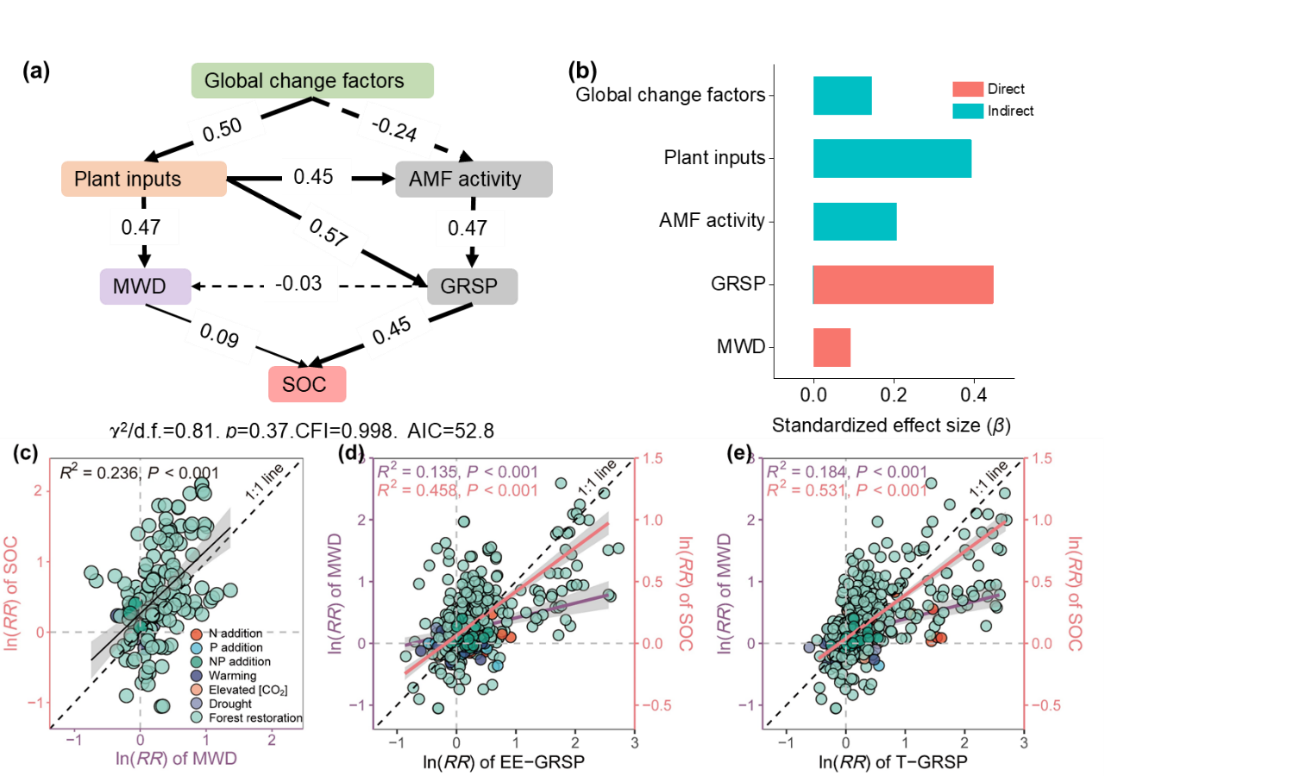
Figure. Contributors to response of easily-extractable glomalin-related soil protein (EE-GRSP) and total GRSP (T-GRSP) to global change factors.(Image by LUO et al.)
File Download: