From field observations to laboratory simulations: Warming promotes manganese-phosphorus remobilization in estuarine sediments
Recently, Lei Gao’s research team from the South China Botanical Garden, Chinese Academy of Sciences, has published a research paper on Journal of Hydrology, exploring the dynamic mechanism of phosphorus (P) release from estuarine sediments response to warming. Combining field investigations and laboratory experiments, the study captured key evidence of the transition from manganese-phosphorus (Mn-P) coupled cycling to iron-phosphorus (Fe-P) coupled cycling in estuarine sediments driven by temperature changes. The results highlight the critical role of Mn cycling in the P release process in estuarine areas with high sedimentation rates.
1. Proposal of scientific questions
Sediment P release (internal P loading) is a crucial process regulating the nutrient structure of water bodies in estuarine regions. The endogenous release of P is mainly driven by the redox behavior of Fe and Mn: under anoxic conditions, microorganisms use organic matter as electron donors to reduce Fe/Mn oxides and release the adsorbed P. In this process, temperature is a key influencing factor, as it directly controls the rate of microbial mineralization of organic matter. However, in estuarine regions with complex hydrodynamic and depositing environments, how seasonal temperature regulates the coupled cycling of Fe/Mn and P, especially in newly deposited surface sediments with unstable redox interfaces, remains unclear.
Against this background, this study aims to address the following two scientific questions: (1) What are the respective roles of Fe and Mn in the P release process driven by warming? (2) Does the decrease in temperature in winter reduce P mobility?
2. Key findings
The study generally follows the logical chain of "field phenomenon discovery → laboratory experiment verification → numerical model quantification", and clearly clarifies the dynamic mechanism of P release response to temperature through an interlocking chain of evidence.
(1) Phenomenon discovered through field investigations: In-situ observations in the Jiaomen Channel found that summer warming led to an increase in the concentration of labile P in sediments, and the coupling relationship between P and Mn was enhanced. Different from the traditional cognition that Fe dominates the P cycling, this suggests that under conditions of high temperature and high sedimentation rate, Mn cycling may play a more important role in the activation of P mobility.
(2) Microcosm experiment verifying the mechanism and reversibility: A temperature-controlled experiment was designed to simulate seasonal alternation, including initial (17℃), warming (32℃) and cooling (17℃) stages. The results confirmed that warming first triggered the reductive dissolution of Mn oxides and the release of associated P, then irreversibly decoupled the Mn-P relationship in the short term through the formation of Mn carbonates, and finally established the Fe-P co-cycling mode.
(3) Numerical model quantifying contributions and simulating kinetic processes: The constructed binary linear regression model of labile P versus labile Fe and labile Mn showed that P released from Mn oxides played a major role in the early stage of warming, while Fe oxides became the dominant source of P release in the later stage.
3. Conclusions and prospects
This study verified the hypothesis that warming promoted P mobility in estuarine sediments. This promoting effect is irreversible, mainly due to the loss of P adsorbents caused by the transformation of Fe/Mn oxides into sulfides or carbonates. Although Mn is crucial for P cycling in newly deposited sediments, its sensitive redox characteristics contribute to the rapid decoupling of Mn-P cycling and the establishment of Fe-P coupling mode. However, this transition is a transient state affected by redox conditions, making solid-phase characterization extremely challenging. Therefore, this study mainly adopts passive sampling techniques (HR-Peeper, DGT and Rhizon) to obtain liquid-phase data. In the future, advanced technologies such as X-ray absorption near-edge structure spectroscopy and cryo-electron microscopy should be attempted to further explore this process without damaging the original structure of the samples.
The research paper entitled “Phosphorus remobilization triggered by reduction of manganese oxyhydroxides in newly-deposited estuarine sediments under warming conditions: Robust evidence from field investigations and a microcosm experiment” was published on Journal of Hydrology (CAS Top Journal, IF=6.9). Dr. LI Rui, a postdoctoral fellow from the South China Botanical Garden, Chinese Academy of Sciences, is the first author of the paper, and Associate Researcher GAO Lei is the corresponding author. The study was supported by the National Natural Science Foundation of China and the Natural Science Foundation of Guangdong Province. Article link: https://doi.org/10.1016/j.jhydrol.2025.134635
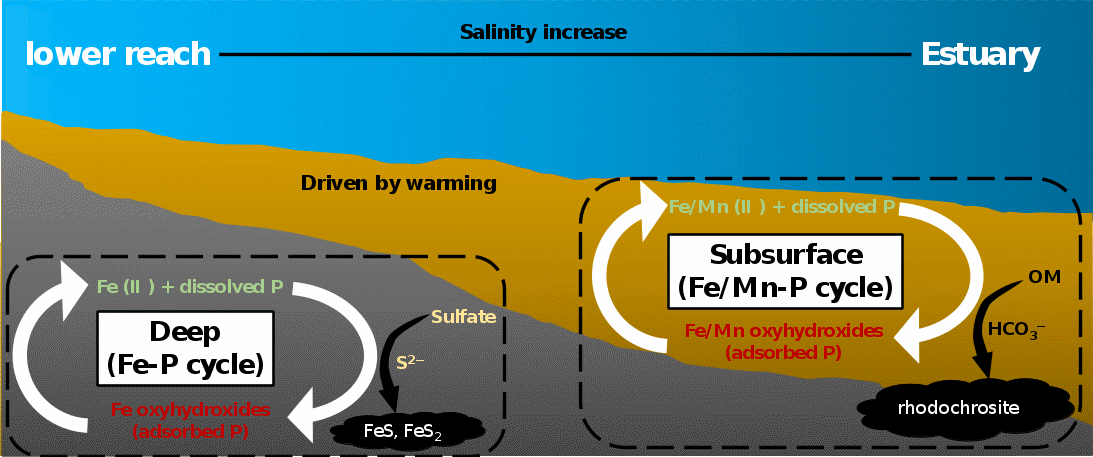
(Image by Li et al.)
File Download: